

Restaurant website design for independent cafés and restaurants
Websites for places people eat, built around the three things diners check before they choose: the menu, the photos and how easy it is to book. Then local SEO and AI search work so the right people find you. Sites from £1,495 excluding VAT.
- Led by Muhammad Younus
- Building websites since 2019
- Top Rated Plus on Upwork
- From £1,495
Written by Muhammad Younus, founder of Renozer. Last updated 21 October 2026. Editorial policy.
- 1Your BusinessCafé, brunch until 3pm, menu online★★★★★ 4.8
- 2Competitor ACoffee shop, no menu listed★★★★ 4.5
- 3Competitor BRestaurant, opens at 5pm★★★★ 4.3
Restaurant website design: what the site has to do
Diners decide in a minute or two, usually on a phone.
Good restaurant website design gets a hungry person from "where shall we go?" to a confirmed table in a few taps, with the menu, prices, opening hours and photos one swipe away. It also gives Google and AI assistants clear, current facts about your food, your area and your hours, so you are the place they suggest.
A restaurant site is closer to a shop window than a brochure. Nobody reads your history page before booking; they scan the menu, check you are open, look at a few dishes and tap the button. Everything we design follows that order, and the pages that matter load quickly on a phone with weak signal outside the venue. The build itself uses our standard website design process, adapted for hospitality.
- Built on
- Squarespace, Wix or WordPress
- Price
- From £1,495, see pricing
- Menus
- Real text pages, easy for your team to update
- Booking
- Your existing system, embedded and tested
- Suits
- Independent restaurants, cafés, bakeries and pubs serving food
- Live in
- Three to six weeks
How diners choose where to eat now
The questions are more specific than "restaurants near me".
People rarely search for a restaurant by name until they have heard of it. They search for an occasion, a dish or a need: a Sunday roast, a dog friendly café, somewhere that can seat twelve, a gluten free brunch. Google answers with a Map Pack and, more and more, with an AI Overview that names two or three places. ChatGPT, Gemini and the other assistants do the same when someone asks them directly.
To be named you need pages and profile details that answer those exact questions, which is the job of local SEO and AI Search Optimisation. This is the kind of list we would track for a café or restaurant every month:
| Customer question | AI Overview | ChatGPT | Gemini | Perplexity | Claude | Copilot |
|---|---|---|---|---|---|---|
| best Sunday roast in Altrincham | Cited | Mentioned | Not yet | Mentioned | Not yet | Not yet |
| dog friendly café near Ramsbottom | Mentioned | Mentioned | Not yet | Not yet | Not yet | Not yet |
| gluten free brunch in Didsbury | Cited | Mentioned | Cited | Not yet | Mentioned | Not yet |
| restaurant for a group of 12 in Bolton town centre | Not yet | Not yet | Mentioned | Not yet | Not yet | Not yet |
| where to eat before a show at Salford Quays | Mentioned | Cited | Mentioned | Mentioned | Not yet | Not yet |
| vegan breakfast near Stockport station | Cited | Mentioned | Not yet | Mentioned | Not yet | Mentioned |
Do restaurants need a website?
Most rely on three things they do not control. Here is what each one does and does not do for you.
| Instagram only | Booking and delivery app pages | Your own website | |
|---|---|---|---|
| Shows the full menu and prices | Rarely, and hard to search | Partly, in the app's format | Yes, as you want it |
| Takes bookings or orders | No | Yes, often with a commission or fee | Yes, through your own system |
| Found for "brunch in your town" | Seldom | The platform ranks, not you | Yes, with local SEO |
| Read by AI assistants | Very little | Some listing details | Yes, as a primary source |
| You own the customer relationship | Partly | The platform does | Yes |
Keep the apps for reach, and make your own site the place they all point to. Not sure where you stand today? Ask for the free audit.
What our café and restaurant websites include
Everything a hospitality site needs, without paying for features you will not use.
Menus, bookings and allergens done properly
The three pages that do the most work on any hospitality site.
Your menu page should be text, not a picture or a PDF. Each section is a heading, each dish has a short line and a price, and dietary labels such as vegan, gluten free or halal are written out so people searching for them, and the assistants answering them, can find them. When the menu changes, your team edits one page and the change shows everywhere, including the link on your Google profile.
Booking should be one tap from every page. We embed the system you already pay for and test the full journey on iPhone and Android, including deposits for large groups. If you take orders for collection or delivery through the site, allergen details must be available before the order is placed and when the food is handed over, as Food Standards Agency guidance sets out. We build that in and suggest checking the current guidance with your local authority.
- Menu sections with prices, written as searchable text
- Dietary and allergen labels agreed with your kitchen
- Booking button visible on every page
- Large group and private dining enquiries routed to the right person
- Seasonal menus scheduled in advance
Restaurant SEO that fills tables, not just rankings
Local search for food is won on detail and consistency.
Restaurant SEO starts with your Google Business Profile: the right primary category, accurate hours including bank holidays, a menu link, real photos and replies to reviews. Then the website backs it up with pages for the things people actually search for, such as Sunday lunch, breakfast, private dining or a specific cuisine, each answering the questions diners ask about them.
For groups with several venues, every location has its own page and profile. Across Trafford, Bury and Salford the questions differ, so the pages do too. Structured data tells search engines your cuisine, price range and opening times in a format they trust, and it supports the Google AI Overviews work that now decides which places get named first.
- Google Business Profile categories, hours, menu and photos
- Pages for the occasions and dishes people search for
- Review replies that sound like you, not a template
- Consistent details on directories and listing sites
- Monthly checks of what six AI assistants say about you
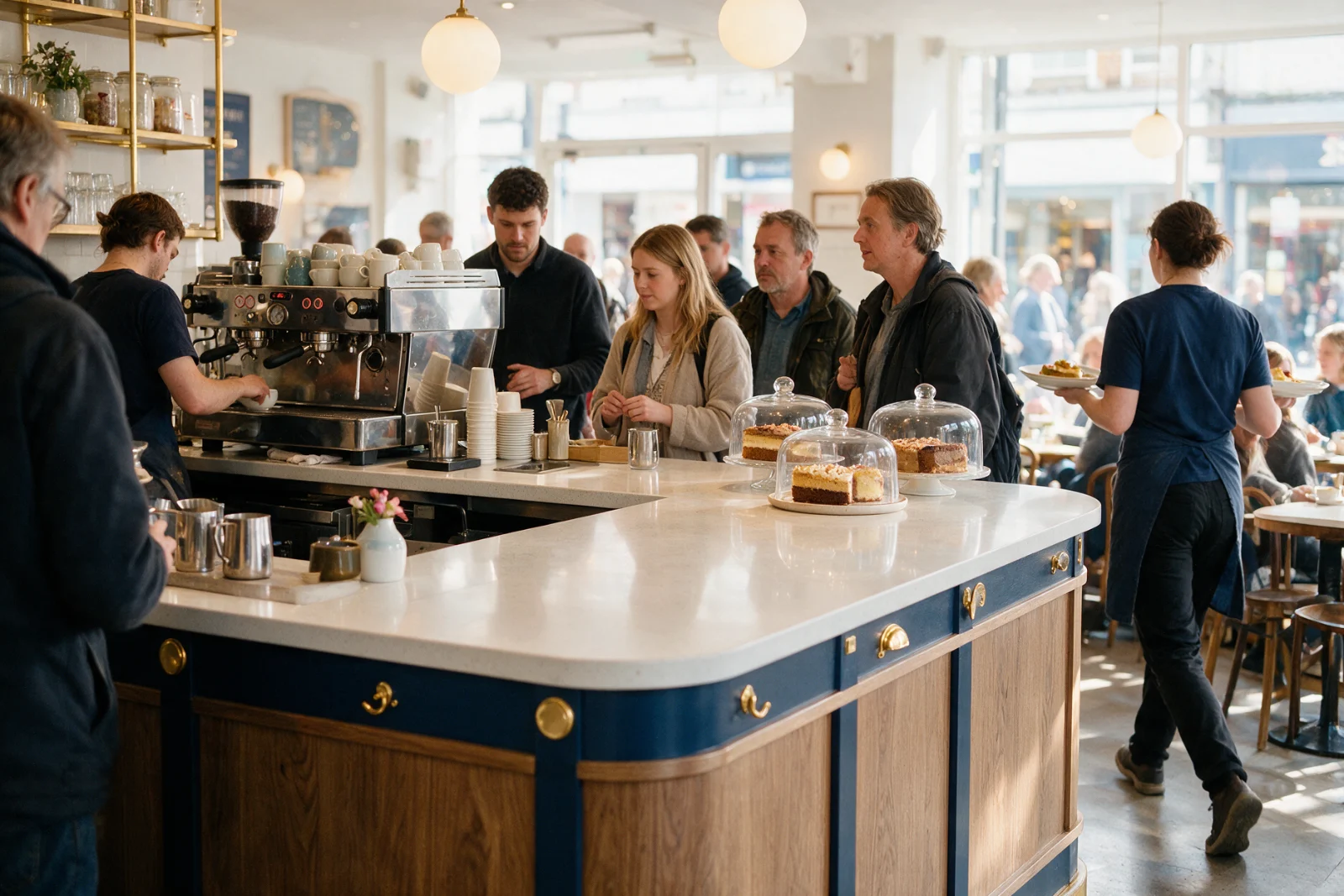
Why restaurant websites so often let the business down
What owners tell us went wrong before, and how we handle each one.
Text menus your team can update from a phone in a few minutes.
Booking embedded on your site, so the diner stays with you.
Images resized and compressed so pages open quickly on mobile data.
One set of hours, updated in both places at once, including holidays.
Training on day one, and Website Care if you would rather we kept it current.
How a restaurant website build works with us
Five steps, planned around service times rather than office hours.
- Week 1Menu and goals call
A short call before or after service to agree pages, booking and what success looks like.
- Week 1Content checklist
Your menu, prices, allergen notes, photos and opening hours gathered in one place.
- Weeks 2 to 3Design
Homepage and menu page designed on phone first, then desktop.
- Weeks 3 to 5Build and booking
Pages built, booking embedded, profile and schema set up, every journey tested.
- Week 5 or 6Launch and handover
Go live, a recorded walkthrough for your team, and old addresses redirected.
The same steps apply to every site we build; read more on how it works.
How much does a restaurant website cost?
One fixed price for the build, and an optional monthly plan for local search.
On Wix or Squarespace. WordPress builds from £1,995. A deposit to start, the balance at launch.
- Menu, booking and allergen pages
- Phone first design for up to eight pages
- Google Business Profile set-up
- Restaurant schema and search settings
- Recorded editor walkthrough
Three-month minimum, then month by month with 30 days' notice.
- Google Business Profile management
- Review reply drafts and photo updates
- New pages for dishes and occasions
- Local citations and directory clean-up
- Monthly plain English report
Prices exclude VAT. Booking systems and platform plans are paid to those providers. Compare every package.
Restaurant and café website questions
See also our FAQ page.
How much does a restaurant website cost?
Do restaurants need a website if they are already on Google and Instagram?
Is a PDF menu bad for SEO?
Can you connect the booking system we already use?
Do we need allergen information on our website?
We have more than one site. How should the website handle that?
How long does a new restaurant website take?
See how your restaurant shows up when people are hungry
A free review of your website, Google profile and what six AI assistants say when someone asks where to eat near you, in two working days.